MSCI Korea has delivered a meteoric 214% over the 12-month period ended June 30, 2026. This has been near unprecedented, across any major equity market globally. The last time Korean equities delivered a similar return was from Sep 1998-July 1999, which was followed by the severe dot-com crash.
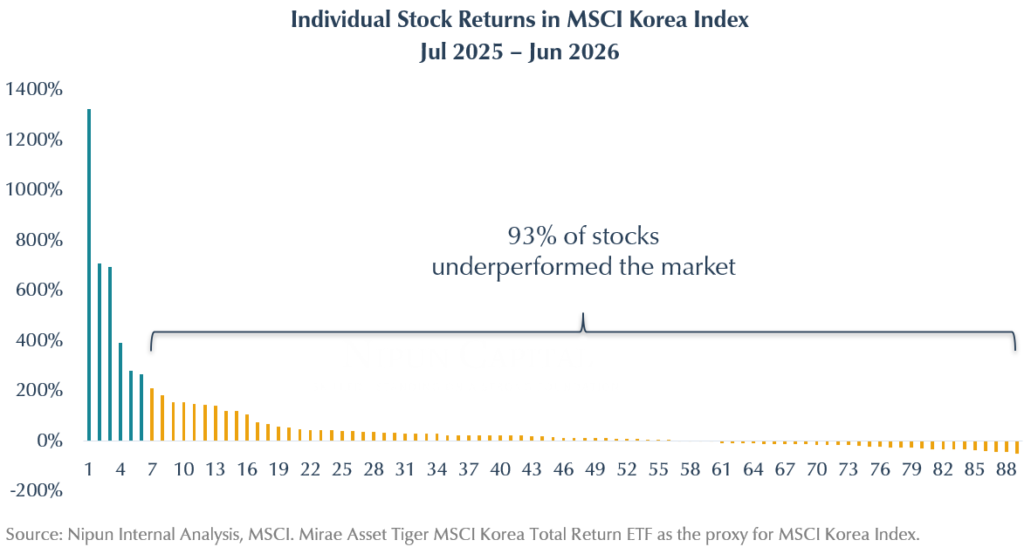
The current rally has been fueled by a handful of stocks, with the largest contributors being Samsung Electronics Co Ltd (005930 KS) and SK Hynix Inc (000660 KS) which have returned 392% and 693%, respectively. On the other hand, over 90% of the stocks in MSCI Korea have underperformed the index, highlighting the huge dispersion in returns, as can be seen in the chart below.
The recent rally in Samsung and SK Hynix has been driven predominantly by domestic retail investors (right-side charts below). Indeed, retail investors have been the largest net buyers of Korean equities overall (left-side chart), providing the marginal source of demand behind the market’s advance. This dynamic has been further amplified by inflows into leveraged single-stock ETFs, whose investor base is also overwhelmingly retail.
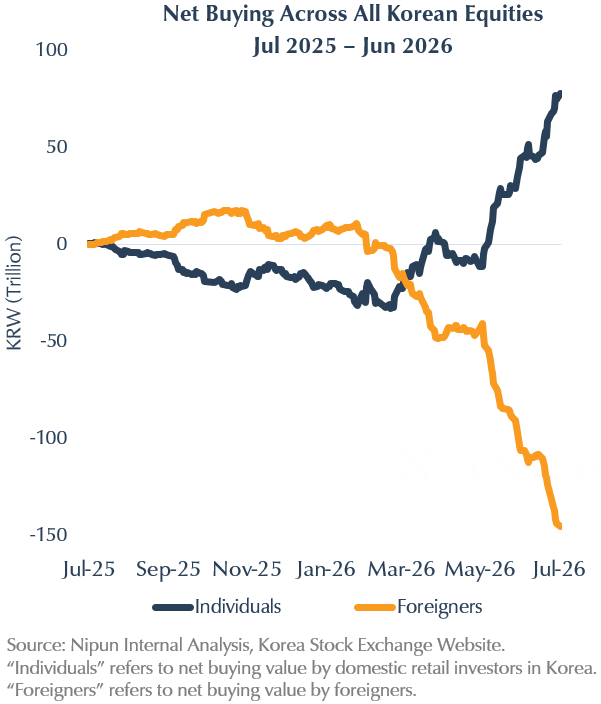
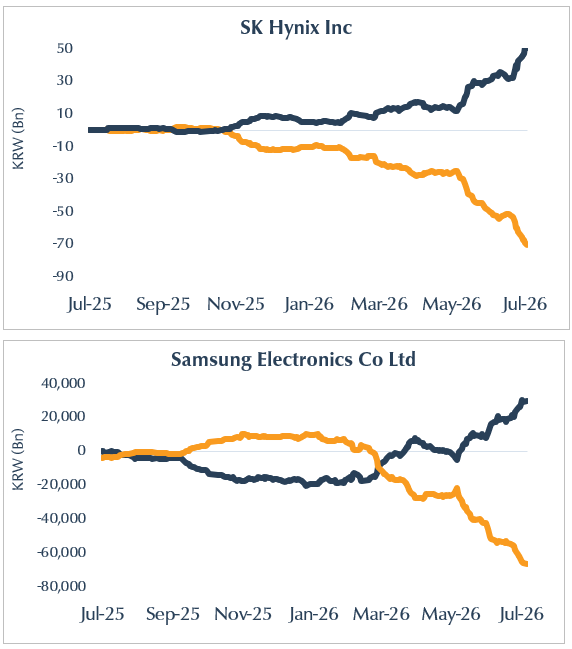
Academic literature, as well as our own research, consistently finds that retail investors are disproportionately attracted to high-volatility, glamour stocks and tend to extrapolate recent price performance. Historically, periods of concentrated retail buying have often occurred in the later stages of momentum-driven rallies, when valuations become increasingly detached from fundamentals. While retail participation alone does not signal an imminent reversal, it has historically been associated with elevated downside risk and weaker subsequent risk-adjusted returns.
For further discussion, please contact Nipun Investor Relations at nora.cheung@nipuncapital.com.
Disclaimer: This post is for informational purposes only and does not constitute investment advice.
Notice and Disclaimer for Reporting Licenses (MSCI): Certain information contained herein (the “Information”) is sourced from/copyright of MSCI Inc., MSCI ESG Research LLC, or their affiliates (“MSCI”), or information providers (together the “MSCI Parties”) and may have been used to calculate scores, signals, or other indicators. The Information is for internal use only and may not be reproduced or disseminated in whole or part without prior written permission. The Information may not be used for, nor does it constitute, an offer to buy or sell, or a promotion or recommendation of, any security, financial instrument or product, trading strategy, or index, nor should it be taken as an indication or guarantee of any future performance. Some funds may be based on or linked to MSCI indexes, and MSCI may be compensated based on the fund’s assets under management or other measures. MSCI has established an information barrier between index research and certain Information. None of the Information in and of itself can be used to determine which securities to buy or sell or when to buy or sell them. The Information is provided “as is” and the user assumes the entire risk of any use it may make or permit to be made of the Information. No MSCI Party warrants or guarantees the originality, accuracy and/or completeness of the Information and each expressly disclaims all express or implied warranties. No MSCI Party shall have any liability for any errors or omissions in connection with any Information herein, or any liability for any direct, indirect, special, punitive, consequential or any other damages (including lost profits) even if notified of the possibility of such damages.
MSCI Indices are unmanaged, reflect no deduction for fees, expenses, or transaction costs, and are not available for direct investment, and these returns were not earned by any investor. The index data presented may not reflect the exact composition, methodology, or risk profile of any portfolio managed by Nipun Capital. Index performance is shown for illustrative purposes only and should not be interpreted as an indication of the performance of any Nipun strategy. Past performance is not indicative of future returns. Commodity Trading Involves Substantial Risk of Loss.